
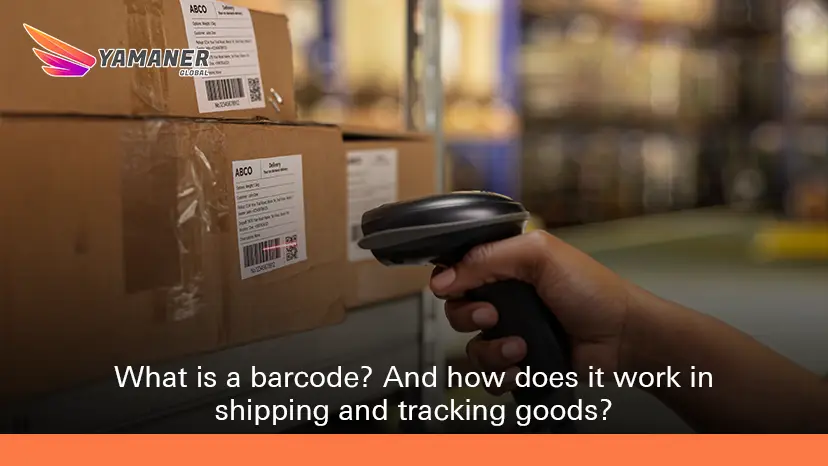
In the modern world of commerce, the question “What is a barcode?” is the gateway to understanding the secret engine that organizes millions of global shipments. Simply put, a barcode is a machine-readable representation of data, composed of parallel lines or geometric patterns that hide vital information about a product and its destination.
What is a barcode on shipping packages?
A barcode on a shipping package acts as the shipment’s “digital ID.” In 2026, it is no longer just a sticker; it is the key to accessing real-time data stored in the logistics cloud. This code contains the shipment’s origin, final destination, weight, and the specific service type (such as Express or Economy).
What is a barcode and how does it work in shipment tracking?
The barcode functions as a digital touchpoint. When scanned, it sends an instant signal to the tracking system. This system links the visual code to your unique tracking number, allowing you to see live updates of your parcel’s location. The importance of barcodes in commerce lies in this transparency, which builds mutual trust between the supplier and the customer.
The importance of barcodes in shipping and delivery processes
The significance of barcodes in modern logistics is highlighted in three core areas that define the efficiency of 2026 supply chains:
- High-Speed Automation: Barcodes enable high-speed conveyor belts and robotic sorters to identify and categorize thousands of parcels in minutes. This replaces manual entry, reducing sorting time by over 90% and allowing for same-day dispatch.
- End-to-End Transparency: Beyond just “tracking,” barcodes provide a step-by-step digital audit trail. They allow both the logistics provider and the customer to monitor the route, identify potential delays early, and confirm the exact time of handovers between hubs.
- Enhanced Security & Accuracy: Each barcode acts as an encrypted data vault. By scanning the code at every checkpoint, shipping companies ensure the package is loaded onto the correct vehicle and delivered to the precise GPS coordinates assigned to it, virtually eliminating the risk of misrouting or loss
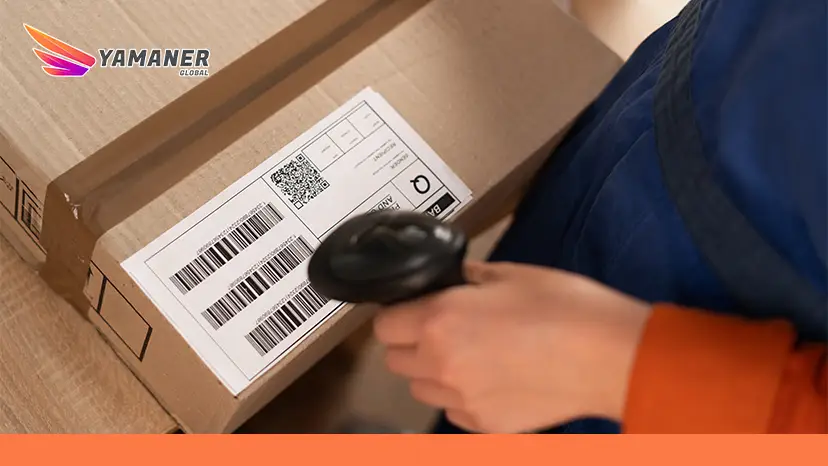
How are barcodes on packages read?
Reading barcodes is performed using scanning devices (Scanners) that utilize laser or digital imaging technology. In Yamaner’s advanced 2026 warehouses, we use smart AI-powered scanners that can read codes from various angles and even in low-light conditions to ensure the flow of shipments never stops.
Types of barcodes used by shipping companies
In 2026, the logistics industry relies on a diverse ecosystem of data carriers. The Types of barcodes used by global shipping firms are selected based on the density of information required and the scanning environment. Understanding these types helps in appreciating how complex data is compressed into a simple sticker:
- Linear Barcodes (1D): The Industry Standard
- Code 128: This is the most prevalent 1D barcode in traditional shipping. It is highly versatile, capable of encoding all 128 ASCII characters, making it ideal for tracking numbers and serial codes. Its high-density structure allows for compact labels that remain easily readable by standard laser scanners.
- ITF-14 (Interleaved 2 of 5): Frequently used on corrugated outer shipping containers, this type is designed to be readable even when printed on low-quality surfaces, ensuring that bulk cartons are tracked accurately through rough transit.
- 2D Barcodes (Matrix): The Information Powerhouse
- QR Codes: In 2026, QR codes have moved beyond marketing; they are now vital for “Smart Shipping.” They store significantly larger amounts of data, including direct links to digital customs declarations, customer contact details, and dynamic website links for instant redirection.
- Data Matrix: These are exceptionally compact and can be read even if partially damaged. Shipping companies use them for small parcels or high-value electronics where space is limited but data integrity (including specific handling instructions or temperature requirements) is critical.
- PDF417: Often seen on international shipping labels (like FedEx or UPS), this “stacked” linear barcode can hold entire files of information, such as the full delivery address and manifest details, serving as a backup if the central database is momentarily unreachable.
The role of barcodes in tracking shipments step by step
- Generation: A unique barcode is created the moment a shipment is registered.
- Initial Scan: When the parcel is received at our warehouses in China or Türkiye.
- In-Transit Scan: At every major hub, such as the port or airport.
- Final Scan: When the shipment reaches the customer’s hands in Saudi Arabia or the GCC.
The difference between a barcode and a tracking number
While these terms are often used interchangeably in casual conversation, they represent two different layers of the same logistics process. Understanding the distinction is key to knowing how your package moves through global hubs:
- Tracking Number: The Human Interface A tracking number is a unique alphanumeric string (e.g., YM2026TRK001) assigned to your shipment. This is the code you, the customer, interact with manually. You copy it from your confirmation email and paste it into our website or app to check the status of your order. It serves as a digital reference point that humans can read, speak, and type.
- Barcode: The Machine Interface The barcode is the graphical representation of that tracking number—and often much more. It acts as a “visual language” designed specifically for rapid processing by optical scanners. Instead of a warehouse worker manually typing 15 digits into a computer at every checkpoint, a scanner “reads” the bars and spaces in milliseconds. In 2026, the barcode on your Yamaner package often contains “hidden” metadata that a plain tracking number doesn’t show, such as the specific sorting bin it belongs to or its priority level.
The Synergy: Think of the Tracking Number as the “Name” of your package and the Barcode as its “Fingerprint.” One is for people to recognize, while the other is for the global logistics infrastructure to process at lightning speed without human error.
The benefits of barcodes in reducing shipping and delivery errors
Thanks to barcodes, human error in shipping has dropped by nearly 99% in 2026. Instead of manually writing addresses, the system reads the encrypted destination and automatically directs the package to the correct container, preventing lost shipments or wrong-way deliveries.
How do barcodes help speed up shipping processes?
Imagine the chaos of trying to sort 10,000 packages manually! Barcodes are the essential tool that eliminates this logistical bottleneck. Here is how they drive speed across the supply chain:
- Lightning-Fast Automated Sorting: High-speed industrial scanners on conveyor belts can read hundreds of barcodes per minute without the need for the belt to stop. This automated system directs parcels to their correct shipping lanes (e.g., the Riyadh or Dubai outbound containers) instantly, increasing sorting speed by over 500% compared to manual labor.
- Instantaneous Data Entry: Instead of wasting time manually typing shipment details at every transit point, logistics staff use a “Scan and Go” workflow. Data is captured in milliseconds, significantly reducing dwell time in warehouses and airports and eliminating processing queues.
- Seamless Customs Pre-Clearance: In 2026, customs authorities rely heavily on barcodes to access “Pre-Arrival Data.” This allows your shipment to potentially receive customs approval while still in the air, reducing wait times at ports from several days to just a few hours.
- Real-Time Fleet Coordination: Barcodes allow Yamaner to coordinate flights and delivery trucks based on the real-time volume of scanned and ready goods. This digital integration ensures your orders from Istanbul or Guangzhou move toward their final destination with zero idle time.
- Elimination of Documentation Delays: Since 2026 barcodes often link directly to digital cloud documents (such as commercial invoices and certificates of origin), there is no need to wait for physical paperwork to be reviewed. Information moves faster than the package itself, clearing the path for delivery.
Using barcodes in inventory management within warehouses
Inside the warehouse, barcodes are the backbone of inventory management. They allow us to know:
- The exact number of parcels currently in stock.
- The arrival date of every individual shipment.
- The precise shelf location for lightning-fast retrieval and dispatch.
Important problems with barcodes and how to solve them
Despite their efficiency, barcodes can face challenges:
- Damage or Tearing: If a label is scratched, it may not scan.
- Solution: At Yamaner, we use high-quality thermal labels resistant to moisture and friction.
- Faded Printing: * Solution: Constant monitoring of industrial printers to ensure sharp black lines.
- Improper Placement: * Solution: We ensure labels are placed on flat surfaces, avoiding corners or folds that distort the image for the scanner.
Understanding What is a barcode? helps you appreciate the precision behind every delivery. At Yamaner, we invest in the latest barcode technology to ensure that every package you order from China or Türkiye reaches you with maximum speed and minimum effort.
Do you have an active shipment?
Enter your tracking number in our dashboard to see the barcode technology in action!
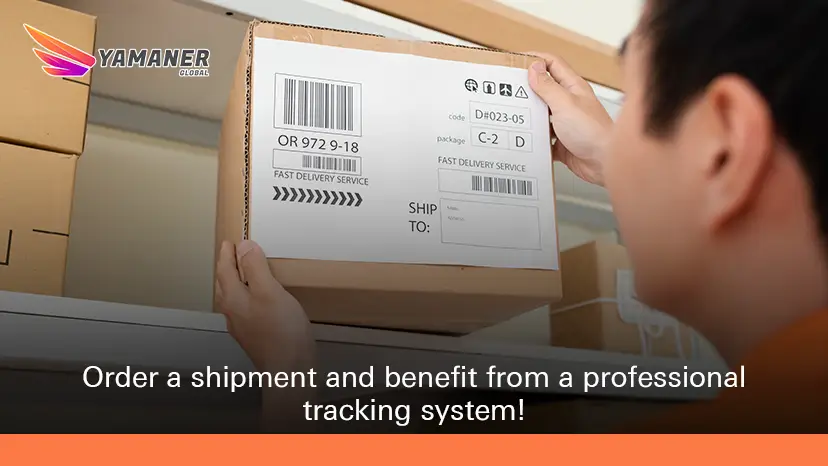
Frequently Asked Questions about barcode
What is a barcode in short?
It is a machine-readable visual representation of data using parallel lines or geometric patterns. It acts as a digital fingerprint for your package, containing its unique ID and destination details in a format that computers can understand instantly.
Why is a barcode used in shipping?
To automate and secure the logistics chain. Barcodes allow for high-speed sorting, eliminate human data-entry errors, and provide total transparency by logging every movement of the package from the warehouse to your door in real-time.
Is a barcode the same as a tracking number?
No, but they are partners. The tracking number is the alphanumeric code (e.g., YM12345) that humans read and type. The barcode is the graphical pattern that machines scan to instantly “read” that tracking number and its associated shipping data without manual typing.
How can a barcode be read?
Barcodes are read using optical scanners (laser or camera-based) or even smartphone cameras. These devices capture the light reflected from the pattern, converting the bars and spaces into digital data that a tracking system processes in milliseconds.